


The Growing Popularity of T20 Cricket Across the World on Playinmatch
When the first Twenty20 match was played in England between two county sides in 2003, the format was an experiment. An entertainment-driven attempt to bring new audiences into cricket grounds by compressing the game into a single evening. Nobody predicted it would become the most commercially dominant sporting product of the 21st century outside the NFL and the Premier League.
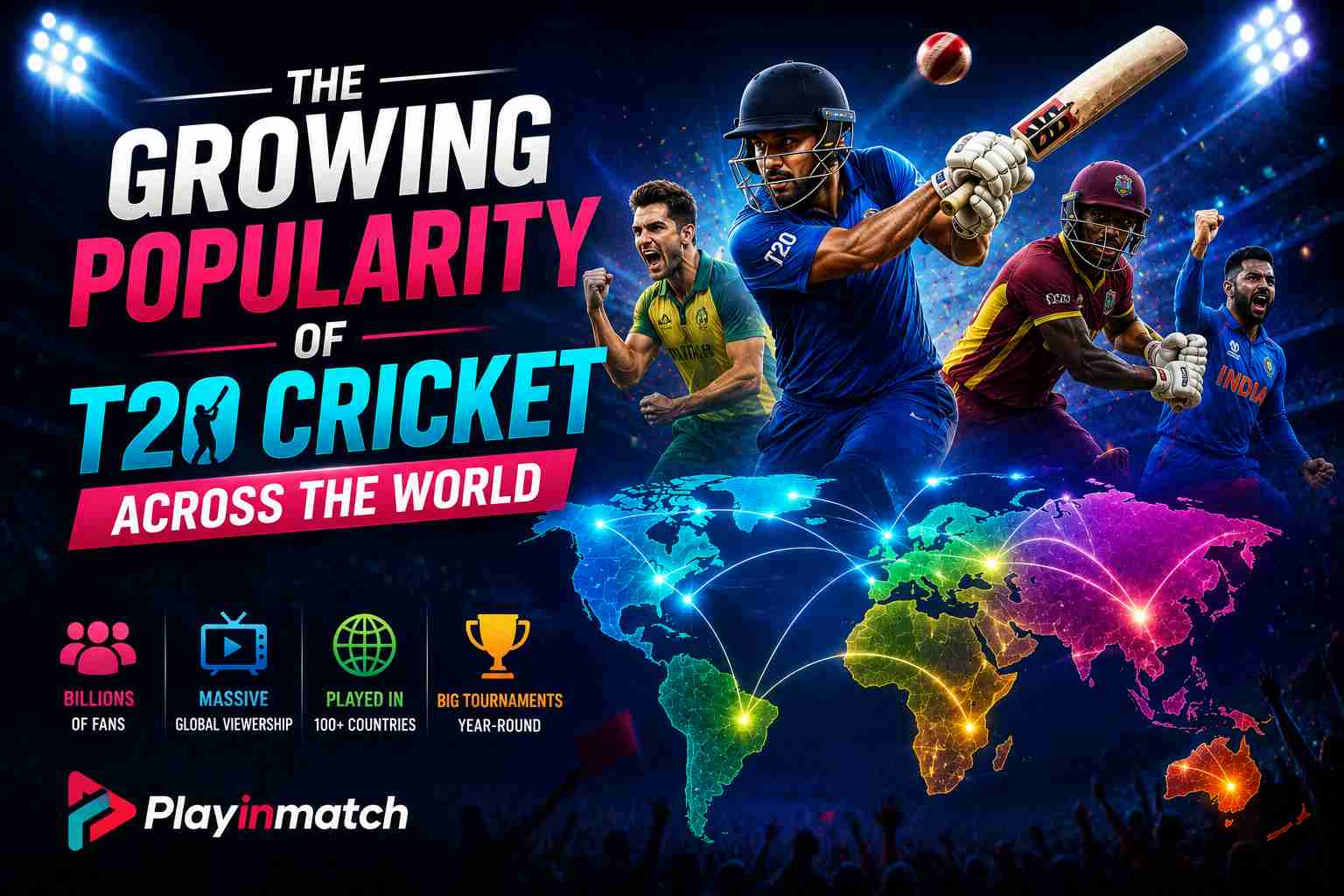
Two decades later, T20 cricket is a global industry. The Indian Premier League alone carries a total business valuation of approximately $18.5 billion in 2026. Franchise leagues operate across six continents. The ICC Men's T20 World Cup 2026, held in India and Sri Lanka, drew record global viewership. And the ICC Women's T20 World Cup, currently underway in England with a 12-team field — the largest in the competition's history — is attracting audiences in countries that had never followed cricket a generation ago.
On Playinmatch, T20 cricket is the primary lens through which millions of fans follow the sport. Understanding why the format has grown so dramatically, and where it stands in 2026, is the foundation of understanding cricket itself.
Why T20 Grew When Other Formats Struggled
The twenty-over format arrived at precisely the moment the global sports entertainment market was demanding shorter, more sharply defined competitive windows. Attention spans were shortening. Broadcast revenue was migrating to digital platforms. Sponsors wanted concentrated, prime-time exposure rather than the diffuse, multi-day engagement that Test cricket and even ODI cricket required.
T20 delivered all of those things simultaneously. A match that could be scheduled from 7 PM to 10 PM in a single evening, where the result was rarely known until the final over, and where every delivery carried consequence, was a product that broadcasters, sponsors, and new audiences could engage with on exactly the same terms as a football league match or a basketball game.
The format also happened to align with the specific talents of an entire generation of Indian batters who had grown up playing aggressive cricket in domestic leagues and who translated naturally into a format where strike rate was the dominant metric. The 2008 IPL arrived with that generation at its peak, and the financial and cultural explosion that followed turned T20 cricket from a county experiment into the world's most aggressively growing sporting product. Do Playinmatch Login Now.
The IPL: The League That Changed Everything
The Indian Premier League is the richest and most influential T20 league in the world, attracting top players, global broadcasters, and massive fan engagement every season. Its total business valuation of approximately $18.5 billion in 2026 makes it the most valuable franchise league in the history of cricket by a significant margin.
The IPL's impact on T20 cricket globally cannot be overstated. It created the template — city-based franchises, short auction windows, mix of international stars and domestic talent, evening scheduling, high production values — that every subsequent franchise league has copied. The Big Bash League in Australia, the Pakistan Super League, the Caribbean Premier League, the SA20 in South Africa, the ILT20 in the UAE, and Major League Cricket in the United States all owe their existence, structure, and commercial viability to the IPL's proof of concept.
IPL 2026 was the most record-breaking edition of the competition in its history. The powerplay run rate reached 10.47 runs per over for the first time. Nine centuries were scored — the highest in a single IPL season. Vaibhav Sooryavanshi, at 15 years old, scored 750-plus runs at a strike rate of 237.30, breaking Chris Gayle's all-time record for sixes in a single T20 tournament. These numbers do not just reflect individual brilliance — they reflect a format that is still evolving and still accelerating, even after 18 seasons.
The Global Franchise Ecosystem in 2026
The most significant development in T20 cricket since the IPL's inception is the emergence of a genuinely global franchise ecosystem — a series of interconnected T20 leagues that allow the same players to compete across different countries, climates, and audiences across a full twelve-month calendar.
SA20 in South Africa is valued at approximately $145 million by 2026, with all six franchises owned by IPL teams. The league's media rights are valued between $40 million and $55 million, and it has rapidly established itself as the flagship T20 competition on the African continent. Its ability to attract IPL-calibre players during the Indian off-season gives it a quality level that South African domestic cricket alone could not sustain.
The Big Bash League in Australia, established in 2011, has a commercial footprint of approximately $115 million and signed a long-term media rights deal worth approximately A$1.13 billion with Foxtel and the Seven Network. It remains one of the oldest and most established franchise T20 competitions outside India, consistently drawing strong crowds during the Australian summer. Its family-friendly scheduling and city-based identity have made it one of Australia's most-watched sports products.
The Hundred in England, launched in 2020, has expanded its reach through £975 million in franchise sales and growing broadcast partnerships. With 50 million followers globally, it has successfully brought a new type of fan to cricket — one who responds to the shorter, faster format and the explicit pitch toward younger and more diverse audiences. Its growing South Asian fanbase in the United Kingdom has provided an unexpected but commercially significant secondary audience beyond the traditional English cricket market.
Major League Cricket in the United States is the most strategically significant new league in the global T20 ecosystem. Launched in 2023, it targets the largest untapped cricket market in the world — a country with a substantial South Asian and Caribbean diaspora, massive broadcast infrastructure, and world-class stadium facilities. Four of the six MLC franchises are backed by IPL ownership groups, ensuring both financial stability and player pipeline access that independent leagues cannot match. With a global audience of approximately 25 million across its first three seasons, MLC's growth trajectory points toward the US becoming a genuine second home for franchise T20 cricket within a decade.
The ICC Tournament Picture
Franchise leagues are the commercial engine of T20 cricket's global growth, but ICC tournaments remain the emotional and competitive summit of the format. The ICC Men's T20 World Cup 2026, held in India and Sri Lanka, was won by India for a third time — making them the first team to successfully defend the title and the most dominant T20 tournament team in cricket history. The tournament drew the highest global viewing numbers in the event's history.
The ICC Women's T20 World Cup 2026, currently underway in England with a 12-team field for the first time, represents the accelerating growth of the women's game. New Zealand are the defending champions from 2024. Australia remain the most decorated side in the competition's history. India, driven by momentum from their 2025 ICC Women's Cricket World Cup triumph, arrive as one of the tournament favourites, with India versus Pakistan at Edgbaston on June 14 already generating the kind of pre-match attention that the men's equivalent has commanded for decades.
What T20's Growth Means for Followers of the Game
The expansion of franchise T20 cricket has fundamentally changed how followers of the sport engage with cricket. There is now competitive T20 cricket available to watch in virtually every month of the year, across multiple time zones, broadcast in multiple languages on multiple platforms.
For analytical followers of the game, this creates both opportunity and challenge. The volume of data available from franchise leagues around the world — IPL, MLC, SA20, BBL, The Hundred — means that individual player form, matchup records, and venue statistics are more comprehensive and more current than at any previous point in the sport's history. Tracking the form of Vaibhav Sooryavanshi from his IPL 2026 campaign into his next tournament appearance, or monitoring Kagiso Rabada's powerplay economy across IPL and SA20, gives the most attentive followers a predictive edge that was simply not available a decade ago.
On Playinmatch App, this data is accessible for every major T20 competition in the current global calendar. Whether you are following the ICC Women's T20 World Cup in England, the Major League Cricket season beginning June 18, or looking ahead to the SA20 and BBL in the southern hemisphere winter, Playinmatch provides the analytical foundation to follow T20 cricket wherever it is being played.
Follow global T20 cricket with live data, match previews, and performance analysis at playinmatch.net.in.